


What is structured cabling?
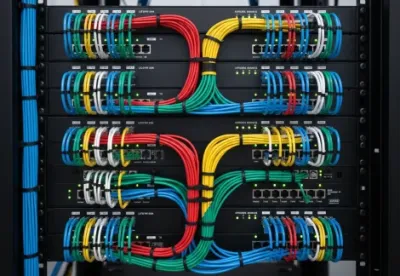
The modern business landscape greatly relies on digital tools and device interconnectivity. This is why it’s difficult to overestimate the importance of a reliable network. A well-designed infrastructure enhances productivity by ensuring seamless communication and provides wider opportunities for scaling.
At the same time, tangled cabling poses significant challenges for enterprises. A disorganized system leads to a wide range of issues, including connectivity problems and difficulty in troubleshooting. Clutters of tangled wires can impede maintenance efforts. In the article, we’re going to discuss what is structured cabling in networking and outline its specifics.
What is Structured Cabling?
Let’s start with the structured cabling definition. It is an organized system of cables and associated hardware that supports multiple types of communication services within a facility. This system integrates various forms of data transmission into a single framework. This approach enhances the efficiency and reliability of a facility.
Versatility is the main SC feature. Due to this peculiarity, telecom facilities can accommodate changing technology and growing demands. Such adaptability comes as an ideal solution for a variety of environments, from small businesses to large enterprise networks. Its modular design contributes to easy upgrades and reconfigurations.
To ensure the integrity and compatibility of SC systems across the world, adherence to international standards is essential. The Telecommunications Industry Association (TIA) and the Electronic Industries Alliance (EIA) set standards for the telecom industry. Compliance with these standards guarantees that hardware of different brands can work together seamlessly and ensures the stability of data transmission.
Core Components of the System
In a SC system, six standard subsystems work together to create an efficient infrastructure. Each subsystem dedicates to facilitating communication within a building or between several facilities.
- Entrance facilities. This subsystem represents a border between the service provider's network and the building's internal infrastructure. These facilities typically consist of a secure area where external cables are terminated and equipment is installed.
- Equipment room. It is the central hub of the telecom system. This room serves as the primary location for all significant electronic equipment.
- Backbone cabling. This subsystem consists of the main connections that link different floors or buildings within the network. It typically consists of fiber optic cables or large copper cables that connect the entrance facilities and equipment room to telecommunications rooms.
- Telecommunications room. They are located on each floor or level of a building and serve as the distribution points for the structured cabling system. These rooms contain patch panels, which are mandatory for cable termination and organization. They allow for the flexible management of connections from the backbone cabling to the horizontal cabling systems.
- Horizontal cabling. This component involves the wiring that runs from the telecom rooms to individual outlets located in work areas. Horizontal cabling is typically installed in a star topology. This cabling can include twisted pair and fiber optic cables, depending on the network requirements and performance expectations.
- Work area. It consists of components that connect users to the telecom system. This includes jacks, connectors, and patch cords, which facilitate the connection of end-user devices to the network. The work area is designed to enable easy access for users.
Together, these six subsystems form a structured cabling system. Sticking to this strategy enables effective communication and networking within buildings. Each component plays a critical role in ensuring that the system operates smoothly and supports various communication technologies.
How It Works
The system operates on two principles, namely, modularity and hierarchy. These principles ensure an efficient and organized setup that caters to the varying complexities of modern networking.
Modular Design
A modular design contributes to flexibility and ease of upgrades. In such designs, each module can be independently managed or upgraded without the need to disrupt the entire system. This feature facilitates configurations that can evolve as organizational needs change.
Hierarchical Structure
The hierarchical structure organizes components in layers based on function and importance. This architecture typically includes:
- core layer (the backbone of the system where high-speed data processing occurs);
- distribution layer (it is responsible for routing data between the core and access layers);
- access layer (this is where end-user devices connect to the network).
Signal management is essential for maintaining performance and reliability within server racks. Signals are routed through dedicated pathways to ensure they reach their destinations. Each server rack is designed to manage these signals, utilizing patch panels as the central element for all connections.
In this regard, patch panels serve as a crucial node within the server rack. They act as physical connection points for incoming and outgoing signals. By organizing connections through patch panels, the system gets facilitated connections and flexible reconfiguration.
The structured layout and planned pathways significantly minimize crosstalk. Furthermore, the organized approach simplifies maintenance processes. Technicians can swiftly identify and troubleshoot potential issues without navigating through a chaotic environment.

Key Advantages of SC for Businesses
- Scalability. As a business grows, adding new workstations becomes inevitable. This flexibility allows organizations to scale their operations without significant disruptions.
- Reduced downtime. When a fault occurs, technicians can react promptly and address issues. This streamlined troubleshooting process contributes to the rapid resolution of problems, which minimizes the impact on operations and maintains productivity.
- Future-proofing. The system is designed to accommodate higher bandwidth requirements and new technologies without the need for a complete overhaul. Thus, businesses can remain competitive and responsive to changing market conditions.
- Redundancy. Structured cabling helps create backup communication paths, which enhances network reliability. This redundancy ensures that if one pathway fails, alternate routes can maintain communication.
Now, you know the explanation of the question “what is a structured cabling system?” To draw the line of the article, note that structured cabling comes as a long-term investment in the efficiency and reliability of your business. By establishing an organized cabling environment, firms can ensure stable IT operations for years and boost performance.
You have questions? We will help you
- 616 Midland Ave, Staten Island, NY 10306
- 1630 Terminal St, West Sacramento, CA 95691
- Mon-Fri: 8am — 6pm