


What is structured cabling?
The modern business landscape greatly relies on digital tools and device interco...
Read more
28/01/2026


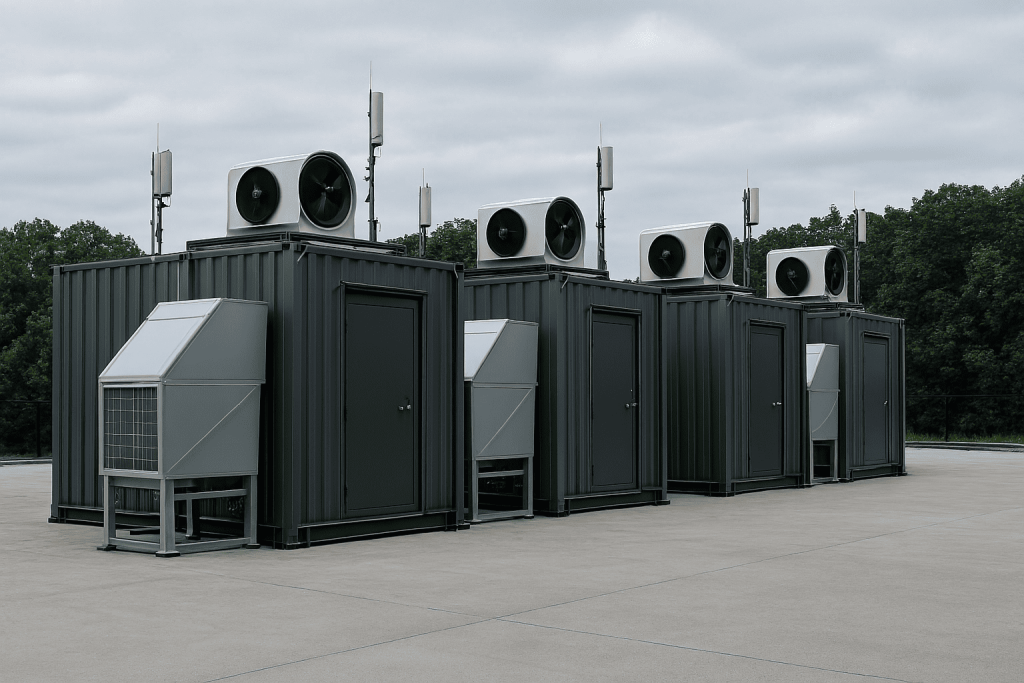
We live in a digital world. It features a high degree of information consumption and high digitalization. Thus, the rapid growth of data consumption and the increasing demand for low‑latency applications, such as streaming, gaming, IoT, and AI‑driven services, are observed. This demand is pushing computing resources closer to end users, giving rise to a new infrastructure model – an edge data center.
The edge DC is a new word in the sphere of network furniture. Unlike large, centralized facilities, edge data centers are smaller; these are strategically located sites designed to process and store data near where it’s generated. In the article, we’re going to discuss the topic and provide an answer to the question “what is an edge data centre?”
To begin with, let’s define the term. The edge data center is a small, decentralized facility that provides compute, storage, and networking resources at the periphery of a network. These facilities are positioned closer to end users than regional or cloud data centers, reducing latency and optimizing bandwidth. Such constructions can be standalone buildings, modular units, or integrated into telecom infrastructure such as cell towers and central offices. Key features of edge data centers include:
These solutions come as a modern alternative to businesses’ demands. The fast pace of the modern evolving world determines the emergency and a rising popularity of such infrastructures.
Moving DC infrastructures to the edge is the latest tendency in the network world. More and more enterprises and small businesses give preference to such solutions due to the following benefits:
These advantages are essential for business holders since they increase data security, workflow efficiency, and computing capabilities. This is why the further distribution of edge DCs and rise in popularity of such solutions is predicted by experts.
When considering the question “what is edge data center?”, you should realize that there are several sub-types of such constructions. The main categories include:
Each sub-type has its purpose of use. Narrow-specialization technicians help choose a suitable option, based on clients’ demands and business requirements.
When considering this class of network infrastructures, it’s necessary to outline its specs. Technical characteristics are required to pick a suitable option that will be capable of satisfying business capacity. Such solutions feature the following specs:
These characteristics and the ability to scale solutions to different capacities make them suitable for large-scale enterprises, mid-size businesses, and small companies. A wide variety of models allows businesses to pick the right solution for every demand.
The popularity of such solutions and high attention to them is mainly determined by their ability to enable next‑generation applications that cannot tolerate high latency. These modern solutions have come to solve the problems arisen in traditional DC infrastructures, so common shortcomings are eliminated in them.
Besides, industries such as autonomous vehicles, telemedicine, AR/VR, and real‑time analytics greatly rely on edge infrastructure due to their features and capabilities. For autonomous vehicles, such solutions guarantee quick reaction and data security. For telemedicine, they ensure confidentiality and low delays. For AR/VR, edge DCs guarantee immersiveness and synchronization. For real-time analytics, an instant analysis and a high efficiency are guaranteed.
Finally, they also play a critical role in supporting 5G networks by bringing compute resources closer to mobile users. Instead of sending all data to a distant central cloud, edge centers process information locally, close to data sources and users. Processing data at the edge significantly reduces response times because data does not have to travel a long distance to the central server and back. 5G networks are designed to support a large number of devices and applications with high throughput and minimal latency.
Now, let’s briefly list the key strengths and weaknesses of edge DCs in a table:
| Pros | Cons |
| Low latency | Higher number of sites to manage |
| Bandwidth savings | Potential space/power constraints |
| Scalability | higher per‑unit cost compared to centralized facilities |
| Improved user experience |
First of all, edge deployment accelerates time‑to‑market, improves service quality, and opens new revenue streams. Companies adopting edge early gain competitive advantage in emerging tech markets due to the integration of advanced tech solutions and physical infrastructures. The use of advanced solutions simplifies workflows and provides businesses with extra opportunities.
Finally, keep in mind that hybrid strategies combining edge, regional, and cloud resources are becoming common. The combination of different types of information analysis and storage allows for creating optimal strategies for stable and fruitful development.Now, you understand the essence of the issue “what are edge data centers?” To draw the line of the article, note that edge data centers are a critical evolution in digital infrastructure, enabling faster, more secure, and more efficient data delivery. Their importance will only grow as demand for real‑time applications increases. However, to ensure maximum performance and reliability of edge deployments, it is important to use high‑quality, purpose‑built server racks. If you need such, contact Sysracks for expert advice and selection of optimal racks for your projects. Skilled managers will consult you, clarify your questions, and assist in selecting suitable options for your cases.
The modern business landscape greatly relies on digital tools and device interco...
We have entered a new era where sustainability is not just a sound but a vital c...
Nowadays, data centers and computing facilities grow like mushrooms in the fores...