


What is structured cabling?
The modern business landscape greatly relies on digital tools and device interco...
Read more
28/01/2026


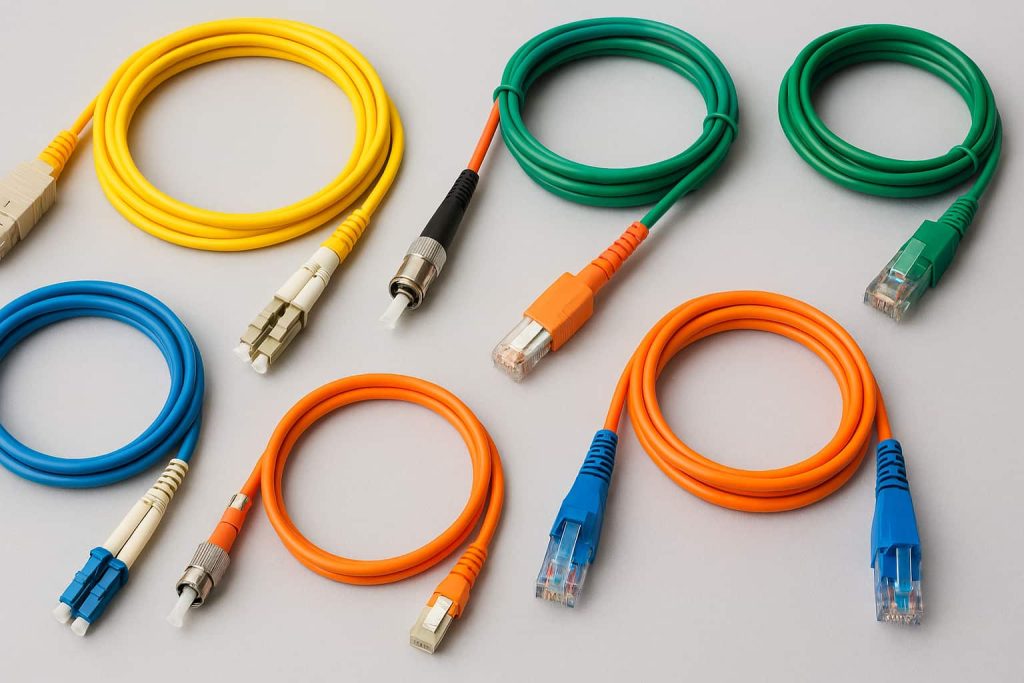
Patch cords are short cables used to connect various network devices and system components. They are typically used in network infrastructure that requires a fast and reliable connection, such as in LANs, data centers, and office environments.
Patch cords come in various types, depending on the data transmission technology used. Patch cords come in different lengths and categories, which impact their ability to transmit data at different speeds and with different traffic volumes. In this article, we’re going to discuss different types of patch cords and outline their features. Our experts explain the specifics of each type of cord and highlight benefits.
Fiber cables are essential components in modern networking infrastructures. They are used to facilitate high-speed data transmission. They come in two types:
These details also differ in their connector types. The most common options include:
Such fiber cables are vital in telecom systems and data centers, where they support crucial applications such as server interlinks, overall network connectivity, and large-scale data processing. The choice between fiber cable patch cord types affects network efficiency, bandwidth, and future scalability, ensuring that data transmission remains fast and reliable in today’s demanding technological environment.
A copper patch cord is an integral part of the network infrastructure, providing a reliable and fast connection between various devices. In practical usage, they are commonly utilized in server racks and office networks. According to the connector type, they can have a straight-through or crossover connector. The straight-through type is used to connect devices operating at the same speed (for instance two computers or two switches). The crossover type is designed to connect devices operating at different speeds (for instance, a computer and a switch).

The twisted pair category determines the maximum data transfer rate. The most common categories are 5e, 6, 6a, and 7. Categories 1, 2, and 4 are rarely used due to their low data transfer rates.
Copper patch cords can have a jacket made of PVC, polyethylene, or polypropylene. PVC jackets are used for indoor use, polyethylene jackets are used for outdoor use and areas with high humidity, and polypropylene jackets are used for extreme operating conditions. Length
Patch cord length can vary from a few centimeters to several tens of meters. The choice of length depends on the distance between devices and the network infrastructure.
Patch cords can have various connector types, including RJ-45, RJ-11, BNC, and others. RJ45 connectors are vital for the functionality of copper cables. They fit into the standard Ethernet ports, meaning that they are compatible with most network devices (computers, routers, and switches). The choice of connector depends on the type of devices being connected and the network standards.
Each patch cord cable type is suitable for different use cases. In most situations, they are used to support different bandwidths and data transmission speeds.
When evaluating network solutions, the choice between fiber optic and copper patch cords can significantly impact performance and functionality. Below, you can find a comparison table that highlights the key parameters of both fiber and copper patch cords:
| Parameter | Fiber cable | Copper cable |
| Transmission Distance | Can transmit data over several kilometers without loss | Typically limited to 100 meters for Ethernet |
| Bandwidth / Speed | Capable of supporting speeds up to 100 Gbps and beyond | Usually supports up to 10 Gbps (Cat 6a) |
| Connector Types | Commonly uses SC, LC, ST, and MTP/MPO connectors | Commonly uses RJ45 connectors |
| Applications | Ideal for high-speed data centers, long-distance telecommunications | Suitable for general household and office networking |
| Cost | Generally more expensive due to materials and installation | More cost-effective and widely available |
| Reliability / Performance | Highly reliable, immune to electromagnetic interference | Can be affected by interference and signal degradation |
| Scalability | Highly scalable for future upgrades, able to support higher bandwidths | Limited scalability; may require upgrades and replacements for higher speeds |
This table illustrates the critical differences between both types of cables, enabling informed decisions based on specific networking needs.
Choosing the right patch cord for your infrastructure involves a careful assessment of several factors, including distance, bandwidth requirements, and the usage environment. Follow the next steps to find a suitable option for your case:
In summary, the selection of patch cords is vital to the efficiency and reliability of your network infrastructure. By understanding the specific needs of your environment you can make informed decisions that support both current and future network demands. Matching connector types to your equipment and prioritizing proper cable management will further enhance your network’s performance and longevity. Planning for scalability today will ensure a robust, adaptable network for years to come.
The modern business landscape greatly relies on digital tools and device interco...

We have entered a new era where sustainability is not just a sound but a vital c...
Nowadays, data centers and computing facilities grow like mushrooms in the fores...