


What’s The Difference Between a Router And a Switch?
Nowadays, data centers and computing facilities grow like mushrooms in the fores...
Read more
29/12/2025


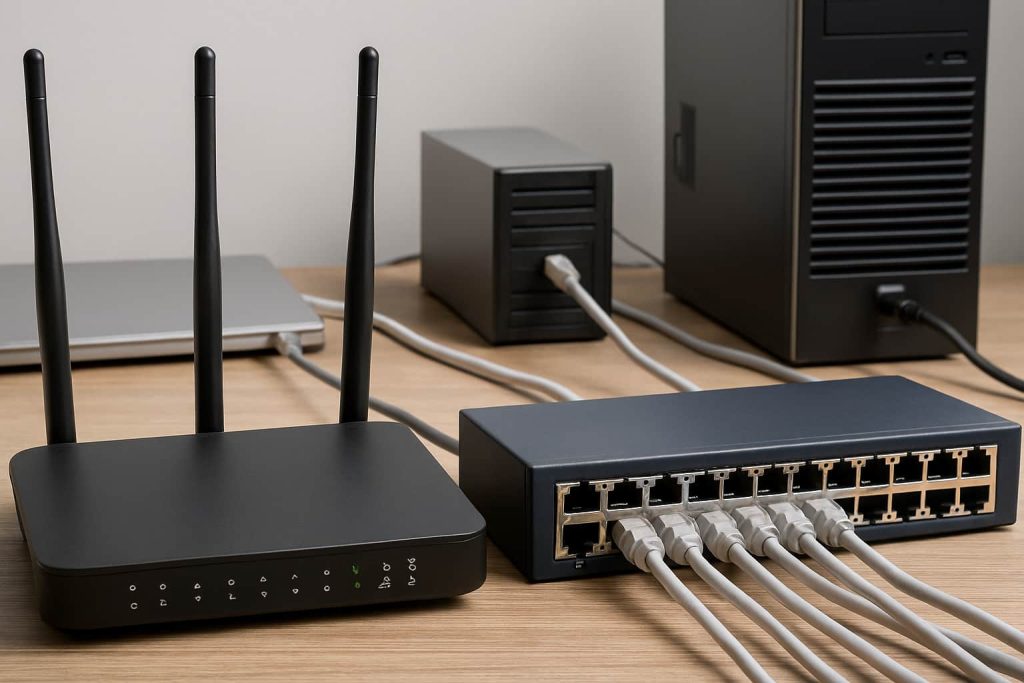
Nowadays, data centers and computing facilities grow like mushrooms in the forest. In this regard, all sorts of telecom devices are in high demand on the market. Their variety is great, but each item is designed to perform its own function.
Routers and switches are indispensable components of any network architecture. It’s impossible to settle a telecom facility without these components since they enable data exchange between devices. Although both types of equipment are designed to transmit data, they have different tasks and operating mechanisms. Understanding their characteristics and differences helps IT specialists make informed decisions when designing and upgrading network systems.
This article will cover the key characteristics of routers and switches to better understand these aspects of network technology. Our experts will answer the question “Are switches and routers the same thing?” and highlight their key differences.
A router is a device that connects different networks and manages the transfer of data between them. Simply put, it’s the “postman” who knows how to route information to the right recipient so it reaches its destination quickly and efficiently. Routers are often used in home and office networks to connect to the internet and to connect multiple devices, such as computers, smartphones, and printers. Key router specifications include:
Before you realize the difference of ethernet switch vs router, you should clearly understand what each device is for. Due to the purpose of use and the specifics of its application, router performs a circle of important functions, including:
Thus, the router is a key device in modern networks. It is used to ensure uninterrupted data exchange between devices and provide their stable connection and security. Its features and functions allow specialists to create efficient, fast, and secure networks for personal and professional use.
Before we get down to the consideration of how is a router different from a switch, let’s discuss what the latter means. The switch is a specialized device that facilitates communication between various devices on a local area network, allowing them to exchange data. Unlike a hub, which forwards incoming data to all connected devices, the switch analyzes the data and sends it only to the specific recipient, significantly improving network efficiency. Key switch characteristics include:
Switches can have features such as VLANs, QoS, security, and traffic monitoring. These features help optimize communications and improve overall performance.
There are two main types of switches: unmanaged and managed. Unmanaged switches are easy to use and require no configuration; they automatically detect devices within one infrastructure and establish connections. Managed switches, on the other hand, offer a wider range of features, allowing administrators to configure network settings, manage traffic, and monitor status.
To sum up, switch is a crucial element of any local area network, ensuring fast and efficient data transfer between devices. The choice between unmanaged and managed switches depends on business needs and the level of control required over the network.

Now, let’s move on to the comparison of network switch vs router. Routers and switches are essential devices that play distinct roles in facilitating communication within and between infrastructures. So, here’s a comparative table with the key differences:
| Parameter | Routers | Switches |
| Purpose | Connects different networks | Connects devices within the same network |
| OSI Layer | Layer 3 | Layer 2 |
| Addressing | Uses IP addresses for routing | Uses MAC addresses for forwarding |
| Traffic direction | Can route traffic to different networks | Directs traffic within the same infrastructure |
| Internet connection | Typically connects to the internet | Usually operates within local area networks (LANs) |
| Typical use | Connecting home or office infrastructures to the internet | Linking devices like computers, printers, and servers within an infrastructure |
| Complexity & cost | More complex and generally more expensive | Simpler and less expensive |
To summarize the article, let us underline once again what difference between router and switch exists. The router and the switch are two devices used in computer networks, and their functions, purposes, and operating methods are quite different. The router’s primary function is to route data packets between different infrastructures. It makes decisions about how and where to forward data based on information contained in the packet headers. The switch operates at the data link layer (Layer 2, OSI) and is designed to connect devices within a LAN. It makes data forwarding decisions based on MAC addresses and forwards data only to the ports where the target devices are located. This reduces network load and improves performance.
Routers are used to connect a local area network to the Internet. They are widely used in offices and large infrastructures to create an infrastructure, especially when traffic needs to be managed between multiple infrastructures. Switches are the primary device for building local area networks. They are used in offices and data centers to connect various devices (computers, servers, etc.) within a single infrastructure.
Nowadays, data centers and computing facilities grow like mushrooms in the fores...
Patch cords are short cables used to connect various network devices and system ...

Mining is a popular type of activity in the modern world. More and more users st...